Codington County Dog Registration Information
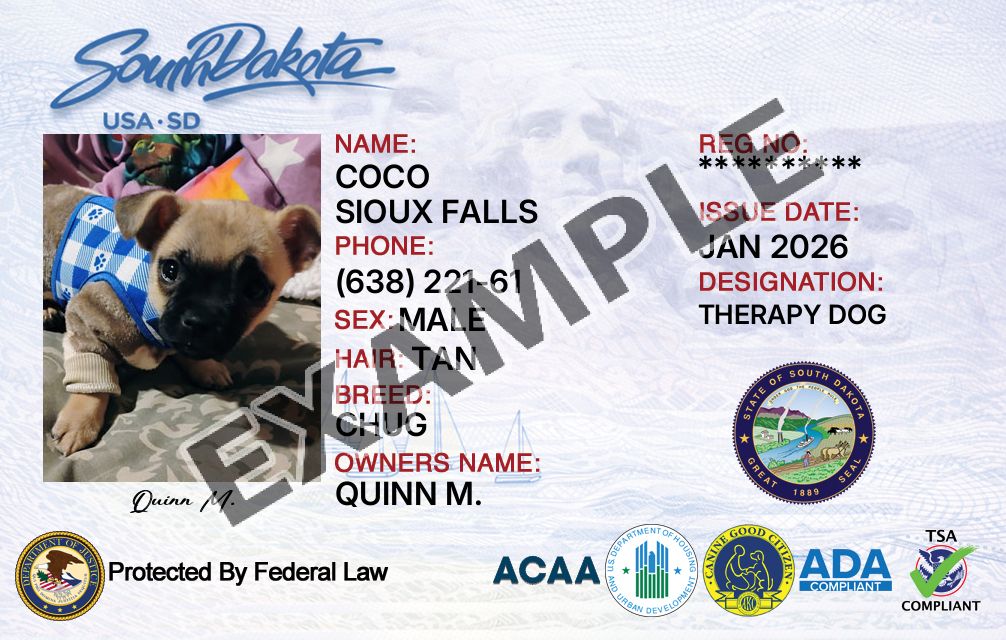
Service Dogs and Emotional Support Animals in Codington, South Dakota
Registering a Dog in Codington County, South Dakota (Including Service Dogs and Emotional Support Dogs)
If you’re searching for where do I register my dog in Codington County, South Dakota for my service dog or emotional support dog, the key point is that “registration” usually means a local dog license (issued by a city/municipality) and/or working with local animal control for enforcement, stray pickup, and ordinance questions. In Codington County, requirements can differ depending on whether you live inside Watertown city limits or in another community or rural area within the county.
- There is no single universal federal “service dog registry” that you must use to make a dog a service dog.
- Emotional support animals (ESAs) are not service animals under the Americans with Disabilities Act (ADA) for public access.
- Even if your dog is a service dog or an ESA, your city may still require a standard dog license and proof of rabies vaccination.
Where to Register or License Your Dog in Codington County, South Dakota
The offices below are the primary official points of contact commonly used by Codington County residents for dog licensing (especially within Watertown) and animal control/law enforcement questions that can come up with licensing, stray dogs, bites, or ordinance enforcement. If you are outside Watertown city limits, you may need to confirm whether your specific municipality issues its own license, or whether different local rules apply in your area.
City of Watertown, South Dakota — Finance Department (Dog Licensing)
Watertown, SD 57201
- Watertown publications indicate dog licenses are handled through the City’s Finance Department.
- If you live within Watertown city limits, this is typically the first office to contact for a dog license in Codington County, South Dakota.
Codington County Sheriff’s Office (Animal/Law Enforcement Issues)
Watertown, SD 57201
- Animal-related law enforcement questions in parts of Codington County served by the Sheriff’s Office
- Stray dog complaints, bite reports, dangerous dog procedures, or ordinance enforcement questions where law enforcement is involved
- Questions about how rural/unincorporated areas handle animal control calls
Codington County Treasurer’s Office (County Courthouse Contact Point)
Watertown, SD 57201-3611
- General county office routing (if you’re unsure which local office handles your issue)
- Helping direct residents to the correct department when responsibilities differ by municipality
Overview of Dog Licensing in Codington County, South Dakota
Dog license in Codington County, South Dakota: what “licensing” means
A dog license is typically a local, government-issued record connecting your dog to you at your current address. In many communities, licensing helps with:
- Reuniting lost dogs with owners
- Verifying rabies vaccination compliance
- Funding local animal control or sheltering functions
- Enforcing local animal ordinances (leash rules, nuisance rules, bite reporting, etc.)
Animal control dog license Codington County, South Dakota: city vs. county responsibilities
In Codington County, animal-related enforcement can involve city departments (for residents inside city limits) and the County Sheriff’s Office (for certain enforcement and public safety functions in the county and smaller communities). That’s why many residents asking where to register a dog in Codington County, South Dakota are best served by starting with the office connected to their address:
- Within Watertown city limits: contact the City of Watertown Finance Department for dog licensing.
- Outside Watertown: confirm whether your municipality issues dog licenses; if unsure, call county/city contacts listed above for direction.
Do service dogs and emotional support dogs still need a dog license?
Often, yes. A dog license is separate from a dog’s status as a service dog or an emotional support animal. A service dog may have special legal protections for access to public places, but that does not automatically replace local dog licensing requirements. ESAs generally do not have public access rights and also do not replace local licensing rules.
What You Need Before Registering a Dog
Common dog licensing requirements Codington County, South Dakota residents should expect
While the exact dog licensing requirements in Codington County, South Dakota can vary depending on municipality, most licensing offices commonly request the items below before issuing a license:
- Current rabies vaccination certificate (non-expired)
- Owner identification (especially if applying in person)
- Proof of address/residency if your city requires it
- Spay/neuter documentation if your fee depends on altered status
- Payment for the licensing fee (fees and late fees vary by municipality)
Why rabies proof is commonly required
Rabies vaccination verification is one of the most common prerequisites for licensing. Local licensing offices frequently use licensing records to support public health and bite-reporting processes. If your rabies certificate is missing details (dog name, vaccination date, expiration date), ask your veterinarian for a corrected copy before you apply.
Steps to Register or License a Dog in Codington County, South Dakota
Step 1: Confirm which office issues licenses for your address
Start by determining whether your home is inside Watertown city limits or in another part of Codington County. This is the biggest factor in deciding where to register my dog in Codington County, South Dakota.
- If you are in Watertown, contact the City of Watertown Finance Department.
- If you are in another community or rural area, call one of the listed official offices to confirm which local entity handles licensing where you live.
Step 2: Gather required documents
At a minimum, have your dog’s rabies vaccination certificate ready. Also prepare spay/neuter documentation if it affects the fee in your jurisdiction.
Step 3: Apply and pay the fee (and ask about renewals)
Many cities license dogs on a calendar-year cycle and may charge late fees after a certain date. Ask:
- When licenses expire and when renewals open
- Whether there is a late fee and when it begins
- Whether replacement tags are available and what they cost
- How updates are handled if you move within Codington County
Step 4: Keep your license information updated
If you move, change phone numbers, or transfer ownership, update your licensing record as soon as practical. Accurate records help animal control and law enforcement return dogs quickly if they’re found.
Step 5: Understand what licensing does (and does not) do
A dog license generally confirms local compliance and ownership information. It does not certify a dog as a service dog or emotional support animal, and it does not grant public access rights.
Service Dog Laws in Codington County, South Dakota
Service dog legal status (not a registry)
A service dog is generally defined by what the dog does: the dog is individually trained to perform tasks for a person with a disability. There is not one universal government registration system you must use to make a dog a legitimate service dog. Instead, service dog status is tied to disability-related need and task training.
Public access: what a service dog can do
In general, a service dog can accompany its handler into most public places where pets are not allowed, as long as the dog is under control and housebroken. Businesses typically may ask limited questions (commonly about whether the dog is required because of a disability and what tasks it is trained to perform), but they generally should not require paperwork as a condition of entry.
How licensing fits in
A service dog may still need to be licensed under local rules (for example, a dog license in Codington County, South Dakota when required by the city where you live). Licensing is an ownership and public health record; it is separate from service dog status.
Training, behavior, and local ordinances
Service dogs must still follow general local animal rules such as leash requirements (unless a leash interferes with task performance and the dog remains under control by other means), vaccination requirements, and nuisance/dangerous animal regulations.
Emotional Support Animal Rules in Codington County, South Dakota
What an ESA is (and is not)
An emotional support animal (ESA) provides comfort by its presence, but it is not trained to perform specific tasks related to a disability in the way a service dog is. ESAs are generally not considered service animals for public access purposes under the ADA.
Housing vs. public access
ESA issues most commonly come up in housing contexts. Public access (restaurants, stores, events) typically follows service animal rules, which do not automatically extend to ESAs.
Do ESAs need to be registered or licensed locally?
If your city requires a standard pet license, an ESA typically still needs the same dog licensing requirements Codington County, South Dakota residents follow for other dogs (such as proof of rabies vaccination). ESA status usually does not replace the requirement for a local dog license.
Dog License vs. Service Dog vs. Emotional Support Animal (Comparison)
| Category | Dog License (Local) | Service Dog | Emotional Support Animal (ESA) |
|---|---|---|---|
| Purpose | Local identification/record for public health and animal control; ties a dog to an owner/address | Assists a person with a disability by performing trained tasks | Provides emotional support/comfort by presence (generally not task-trained) |
| Who issues it | City/municipal licensing office (varies by where you live in Codington County) | No single issuing agency; status is based on disability-related need and task training | No single issuing agency; typically supported by clinical documentation in relevant contexts |
| Typical documentation | Rabies vaccination certificate; sometimes proof of spay/neuter and proof of residency | No universal “registration”; may be asked limited questions in public settings | Often a letter/documentation for specific situations (commonly housing-related); not a public access pass |
| Public access to businesses | No | Generally yes, when the dog is under control and housebroken | Generally no (ESA is not the same as a service dog for public access) |
| Does it replace local licensing? | N/A | No; a service dog may still need a local dog license | No; an ESA may still need a local dog license |
Frequently Asked Questions
Where do I register a dog in Codington County, South Dakota if I live in Watertown?
For Watertown city-limit addresses, dog licensing is typically handled through the City of Watertown’s Finance Department. Use the official office details in the “Where to Register or License Your Dog in Codington County, South Dakota” section above to call ahead and confirm current requirements and fees.
If I live outside Watertown, who handles dog licensing?
Some requirements differ by municipality. If you are outside Watertown city limits, start by calling the City of Watertown main line or the Codington County Treasurer’s Office to confirm which local government office handles licensing at your address. If the issue involves enforcement, stray dogs, or public safety, the Codington County Sheriff’s Office may also be relevant depending on location.
Do I need proof of rabies vaccination to get a dog license?
Many local licensing programs require a current rabies vaccination certificate before issuing a license. Bring a copy that clearly shows your dog’s identification details and the vaccination expiration date.
Is there an official registry I must use for my service dog?
No. There is not one universal federal service dog registry used to validate service dogs. Service dog status is generally based on disability-related need and task training, while local licensing is handled separately by the city/municipality.
Will an emotional support animal letter replace a local dog license?
Usually not. ESA documentation and local licensing serve different purposes. If your municipality requires licensing, your ESA generally still must meet the same licensing rules (such as proof of rabies vaccination).
What should I ask when I call about animal control dog license Codington County, South Dakota rules?
- Does my address fall under Watertown licensing or another municipal licensing program?
- What documents are required (rabies, spay/neuter proof, ID, proof of address)?
- What are the fees and late fees, and when do renewals open/close?
- How do I update the license if I move within Codington County?
Register A Dog In Other South Dakota Counties
Select your county below to get started with your dog’s ID card. Requirements and license designs may vary by county, so choose your location to see the correct options and complete your pup’s registration.
- Aurora County Dog Registration
- Beadle County Dog Registration
- Bennett County Dog Registration
- Bon Homme County Dog Registration
- Brookings County Dog Registration
- Brown County Dog Registration
- Brule County Dog Registration
- Buffalo County Dog Registration
- Butte County Dog Registration
- Campbell County Dog Registration
- Charles Mix County Dog Registration
- Clark County Dog Registration
- Clay County Dog Registration
- Corson County Dog Registration
- Custer County Dog Registration
- Davison County Dog Registration
- Day County Dog Registration
- Deuel County Dog Registration
- Dewey County Dog Registration
- Douglas County Dog Registration
- Edmunds County Dog Registration
- Fall River County Dog Registration
- Faulk County Dog Registration
- Grant County Dog Registration
- Gregory County Dog Registration
- Haakon County Dog Registration
- Hamlin County Dog Registration
- Hand County Dog Registration
- Hanson County Dog Registration
- Harding County Dog Registration
- Hughes County Dog Registration
- Hutchinson County Dog Registration
- Hyde County Dog Registration
- Jackson County Dog Registration
- Jerauld County Dog Registration
- Jones County Dog Registration
- Kingsbury County Dog Registration
- Lake County Dog Registration
- Lawrence County Dog Registration
- Lincoln County Dog Registration
- Lyman County Dog Registration
- Marshall County Dog Registration
- McCook County Dog Registration
- McPherson County Dog Registration
- Meade County Dog Registration
- Mellette County Dog Registration
- Miner County Dog Registration
- Minnehaha County Dog Registration
- Moody County Dog Registration
- Oglala Lakota County Dog Registration
- Pennington County Dog Registration
- Perkins County Dog Registration
- Potter County Dog Registration
- Roberts County Dog Registration
- Sanborn County Dog Registration
- Spink County Dog Registration
- Stanley County Dog Registration
- Sully County Dog Registration
- Todd County Dog Registration
- Tripp County Dog Registration
- Turner County Dog Registration
- Union County Dog Registration
- Walworth County Dog Registration
- Yankton County Dog Registration
- Ziebach County Dog Registration